What Does Architectural Visualization Cost in 2026? The Full-Cost Calculation for Practices
The question "what does a rendering cost?" cannot be answered honestly with a single number – and yet that is exactly the answer most practices are given. External providers quote a price per image, software vendors quote a licence fee, and both leave out the largest cost block: your own working time. This article finishes the calculation that the usual price lists break off halfway through.
Disclosure: This article comes from the team behind VisioPlan. We are of course not neutral here, which is why every assumption is stated openly so you can replace it with your own – research as of: August 2026.
The four cost models at a glance
In practice there are four routes to a visualization. They differ not only in price, but in which costs become visible at all.
External visualization. A specialised studio handles concept, production and revisions. The price is transparent because it appears on an invoice. What does not appear on that invoice is briefing, coordination rounds and your own review time.
In-house production with conventional rendering software. The practice works with Enscape, Lumion, D5 Render or Twinmotion. The licence fee is visible. The far larger share stays invisible: model preparation, entourage, material assignment, camera work, compute time, post-production.
AI-assisted platform. Image production itself is reduced to minutes. A monthly subscription is visible. What stays invisible – and this is regularly glossed over – is that concept and design judgement remain entirely with the human.
Hybrid. In-house production for variant studies and coordination images, external commissioning for the one key visual that has to carry the marketing. In many practices this is effectively the default, without anyone ever having decided it.
External visualization: what the market asks in 2026
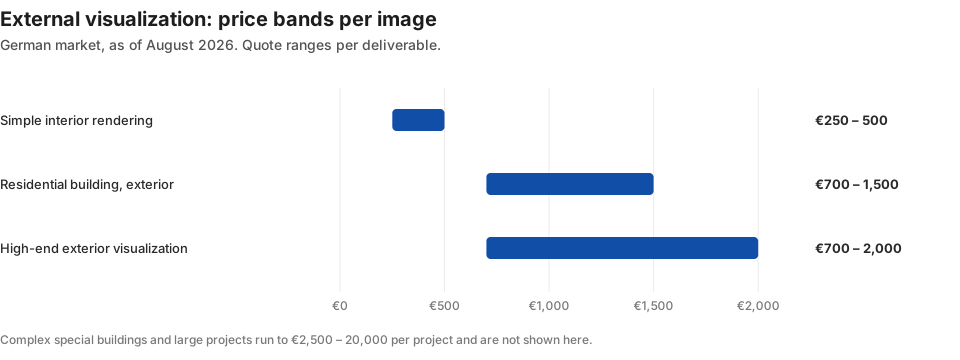
The price range on the German market is wide, but it is surprisingly well documented. For a single image, quotes in 2026 typically sit between €250 and €3,000. Within that range, clear bands have formed:
| Deliverable | Price band per image |
|---|---|
| Simple interior rendering | €250 – 500 |
| Residential building, exterior view | €700 – 1,500 |
| High-end architectural exterior visualization | €700 – 2,000 |
| Complex special buildings, listed properties, large projects | €2,500 – 20,000 (project total) |
For a complete marketing package for an apartment building with around ten unit types, market prices for a full visualization strategy run from €10,000 to €30,000.
What drives the price is not primarily resolution or compute time. The decisive factors are the complexity of the architecture, the number of viewpoints, the level of detail in the scene, the delivery speed required – and, top of the list when quotes get renegotiated, the number of revision rounds. We return to this point, because it is the real cost driver in all three models.
What a studio price actually contains
Before we compare the models, one point has to be clear, because it is where many comparisons become dishonest: a studio image and a self-produced image are not the same product.
A visualization studio's price includes work that no software contains:
- Concept and image idea. Which viewpoint tells the story of this project? What time of day, what season, what use shown in the frame? That is a design decision, not a technical one.
- Art direction. Composition, lighting, colour dramaturgy, entourage selection – the difference between a correct image and an effective one.
- Advice, including disagreement. A good studio tells you when the viewpoint you asked for makes the building look worse.
- Liability and commitment. Deadlines, usage rights, obligation to rectify.
- Capacity on demand. Six images in ten days without anyone in your own office dropping something else.
Producing in-house or using a platform buys you the production – not those five points. Your own practice has to supply them. That is precisely why a cost comparison is only honest if your own concept time is counted. We do that explicitly below.
Producing in-house: the calculation nobody makes
The most common error with in-house production is: "a colleague just does it on the side." There is no such thing as "on the side" in business terms. Every hour spent internally on a rendering is either a fee-earning hour missing elsewhere, or an overhead hour the practice absorbs.
The German chambers of architects calculate the office hourly rate with an established formula:
Hourly rate = (gross salary × overhead factor) ÷ project hours + 10 to 15 % risk and profit
The overhead factor averages 2.7 according to AHO. It is lower in very small practices and higher in practices above fifty staff. It covers premises, technology, administration, insurance, training and idle time.
A worked example with deliberately conservative figures:
| Item | Value |
|---|---|
| Gross annual salary of a project architect | €52,000 |
| Overhead factor (AHO average) | 2.7 |
| Full annual cost | €140,400 |
| Actual project hours per year | 1,400 h |
| Cost per hour | €100 |
| plus 12 % risk and profit | around €110/h |
The 1,400 project hours are not a trick: the ratio of fee-earning to non-fee-earning work in planning practices is normally calculated between 60:40 and 85:15. Anyone budgeting 1,800 hours is budgeting themselves poor.
At €110 per hour, an in-house rendering costs more than a cheap studio image from the fourth working hour onwards. That threshold is the core of the whole discussion.
Licence costs are almost a footnote by comparison. As of August 2026 the common tools sit at roughly €410 to €920 per seat per year – Twinmotion is even free for companies under one million US dollars in annual revenue, Enscape and D5 Render sit around €430 and €420 respectively, Lumion between €460 and €920 depending on tier. Spread across ten projects a year, that is a two-figure amount per project. The licence is never the problem. The hours are.
AI platform: where the price per image lands
On an AI-assisted platform the cost structure shifts fundamentally, because the most time-consuming part of conventional production disappears: manually placing entourage, vegetation and surroundings, assigning materials, and waiting for compute. How far that automation goes is shown by the Google Viewer, which takes the urban context from real 3D geodata.
For reference: on our own platform the price per image works out at somewhere between cents and low single-digit euros; the current tiers are listed on the pricing overview. How those tiers compare with the rest of the field is in our comparison of ten AI rendering tools.
And here is where this article becomes uncomfortable: that number on its own is worthless.
Image generation itself runs fast – that is the honest advantage. But concept, choice of viewpoint, detail decisions and the judgement of whether the result represents the project correctly remain entirely with the human. An image does not exist because a computation finished; it exists because somebody decided what should be visible. Why exactly that part of the process is the one AI covers worst is the subject of our article on the “missing middle” of AI in architecture.
Budget realistically for around one hour per finished rendering – from model preparation through camera setup to selecting from the generated variants. That is substantially less than with conventional software, but it is not zero. Anyone budgeting five minutes is budgeting past reality and will be disappointed.
In this view the subscription price is the smallest item. What matters is that the number of hours per image falls – not that it disappears.
The real cost driver: revision rounds
In all three models the same variable decides the final cost, and it appears in no quote: how often the image has to change before it is signed off.
With external commissioning, one or two rounds are typically included depending on the contract. Each further round costs between ten and twenty per cent of the image price – and, more importantly, several days of turnaround. If the client wants a different façade colour on Thursday and the presentation is on Monday, that is no longer a money question but a scheduling one.
With in-house production on conventional software, a change costs between half an hour and several hours per image depending on depth – swap materials, recompute, retouch.
On an AI platform, regeneration itself is the cheapest part of the process. What remains is the time to decide which variant is the right one.
The practical effect is less the saving per round than the changed conversation: when a variant costs minutes rather than days, client meetings run differently. You show three options instead of defending one.
Worked example: six exterior visualizations for an apartment building
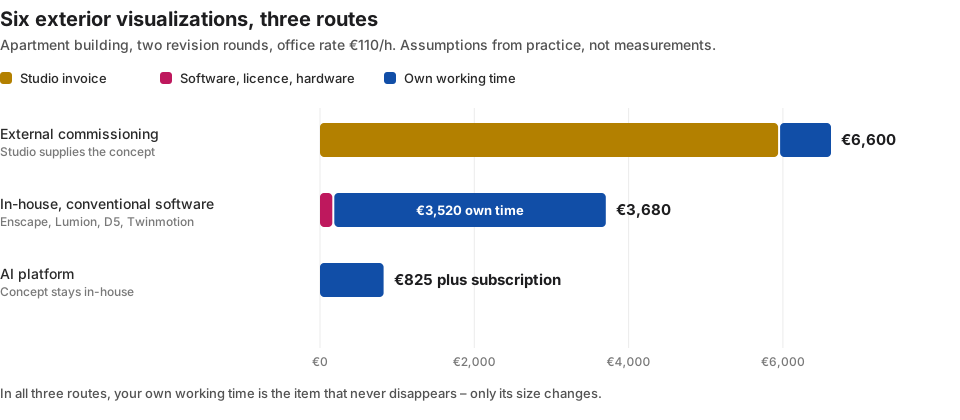
A realistic scenario: an apartment building, six exterior viewpoints for the planning application and marketing, two revision rounds, a two-month project duration. Office hourly rate €110.
Route 1 – External commissioning
| Item | Cost |
|---|---|
| 6 images at €900 | €5,400 |
| Second revision round (10–20 %) | €540 |
| Internal time for briefing, coordination, review (6 h) | €660 |
| Total | around €6,600 |
Route 2 – In-house with conventional rendering software
| Item | Cost |
|---|---|
| First image incl. model preparation (8 h) | €880 |
| 5 further images at 3 h | €1,650 |
| 2 revision rounds (0.75 h per image, 9 h) | €990 |
| Licence share (1 seat, 10 projects/year) | €43 |
| Hardware share (workstation €3,500, 3 years, 10 projects/year) | €117 |
| Total | around €3,680 |
Route 3 – AI platform
| Item | Cost |
|---|---|
| Subscription, 2 months | see pricing overview |
| 6 images at 1 h incl. concept and camera setup | €660 |
| 2 revision rounds (1.5 h in total) | €165 |
| Total | €825 plus subscription |
The gap is considerable: your own working time falls from 32 hours with conventional software to 7.5 hours, and only a subscription costing more than around €2,850 for two months would make route three more expensive than route two. But read the tables closely: in all three routes, the largest item after the studio invoice is your own working time. And route three still lacks everything a studio supplies in concept, art direction and disagreement.
All hour figures are practical assumptions, not measurements. Replace them with your own – the structure of the calculation stays the same, and that is what matters.
Break-even: when each model pays
Up to about four images a year, building internal capacity does not pay. The learning curve never amortises and external commissioning is the cleanest route.
Between five and roughly fifty images a year, in-house production carries – and in this range the difference between conventional software and an AI-assisted platform is largest, because it repeats with every image.
Once variant work becomes routine – competitions, client coordination, phased marketing – the question is no longer decided on price per image but on the turnaround time of a change.
Regardless of volume, external commissioning stays right for the one image that carries the marketing. For a key visual that decides the sale of thirty apartments, a four-figure sum is not a cost question.
For most practices the workable answer is therefore not "either/or" but a deliberate split: internal capacity for volume, variants and speed – external commissioning for the image where art direction makes the difference.
Frequently asked questions about visualization costs
What does a single rendering cost in 2026?
Commissioned externally in Germany, typically between €250 and €3,000 depending on complexity and level of detail. High-end exterior visualizations usually sit between €700 and €2,000.
Why is in-house production not automatically cheaper?
Because working time has to be valued at the office hourly rate, not at salary. At a realistic rate of around €110 per hour, an in-house image exceeds the price of a cheap studio image from the fourth working hour onwards.
How do I calculate my own office hourly rate?
Gross salary times overhead factor, divided by actual project hours, plus 10 to 15 % risk and profit. The overhead factor averages 2.7 according to AHO. The chambers of architects publish calculation aids for this.
Do AI tools make visualization studios obsolete?
No. They move the boundary. What a studio delivers in concept, art direction and advice is not replaced by any tool. What shifts is the volume of images for which external commissioning still pays at all.
Which cost block is most often overlooked?
Revision rounds and your own coordination time. Neither appears in any quote, and together they routinely account for twenty to thirty per cent of total cost.
Conclusion
The honest answer to "what does a rendering cost?" is: it depends whose hours you count. Comparing invoice totals alone means comparing the smaller half.
Three variables decide the actual cost – your own office hourly rate, the number of revision rounds, and whether concept and art direction are bought in or supplied yourself. Any practice that quantifies those three once, properly, can make the choice between external, in-house and platform in twenty minutes – and will not have to reopen it for years.
How the cost picture compares against the established rendering tools in detail is broken down in our 2026 ROI ranking. If you first want to understand how AI-assisted rendering works technically and where its limits are, the complete 2026 guide is the right starting point.